
Most sports betting strategy, covered in our main Sports Betting Strategy guide, is about predicting outcomes better than the market. Matched betting and arbitrage take a different route: both try to extract value from the structure of prices or promotions while reducing dependence on who actually wins.
Quick comparison
Two methods, two different sources of value
Arbitrage betting
Use different sportsbooks' best prices on every possible outcome when the combined implied probability is below 100%.
- Value source: odds differences
- Needs multiple books or markets
- Margins are usually small and short-lived
Matched betting
Place a qualifying wager to unlock a bonus, then use an opposing position to reduce the outcome risk and convert promotional value.
- Value source: bonus or promotion
- Needs careful offer-term tracking
- Often easier to plan than live arbitrage
Arbitrage
How a genuine surebet works
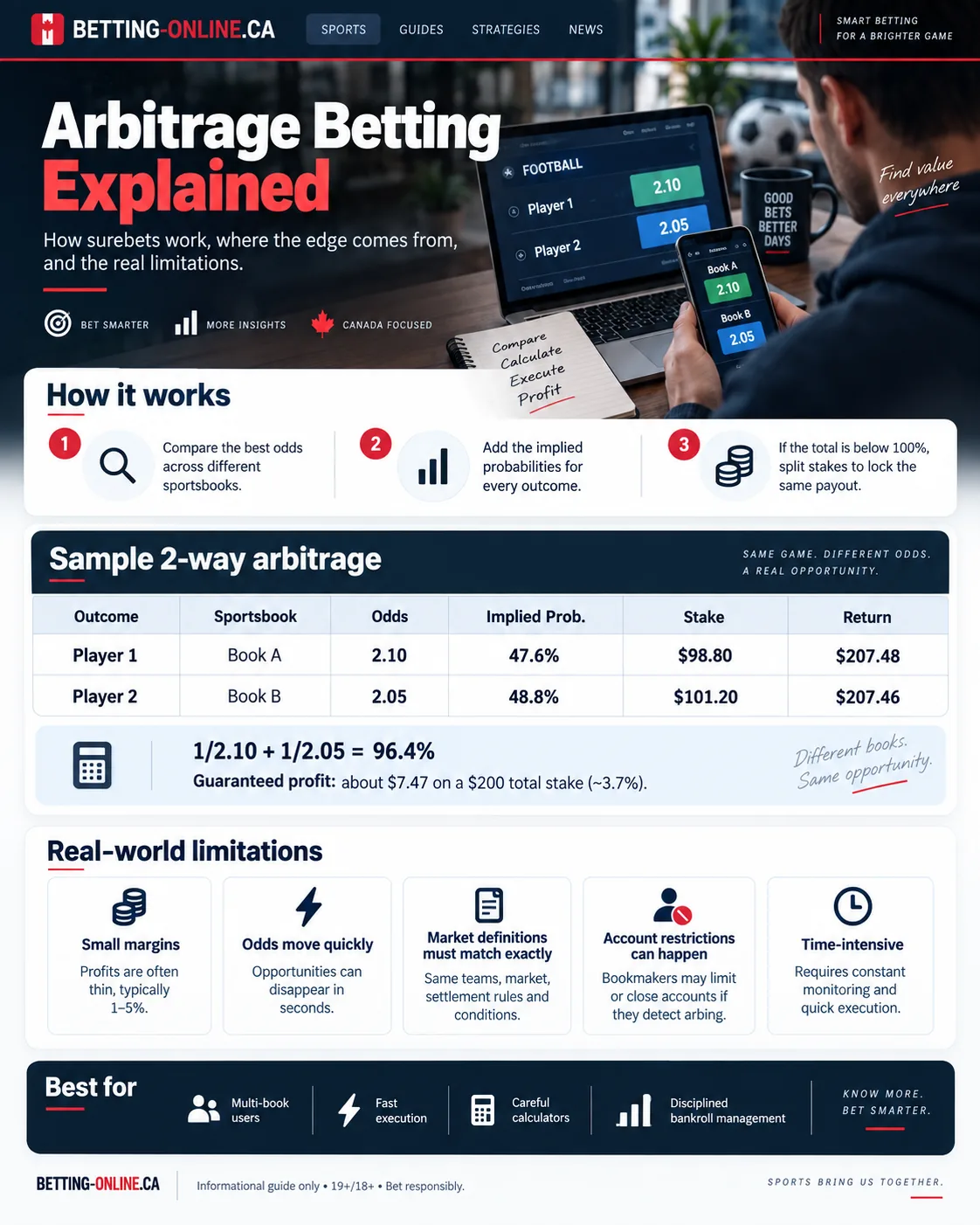
Different sportsbooks price the same event independently. Occasionally, the best available prices across books are far enough apart that covering every possible outcome produces a combined implied probability below 100%. When the market definitions and settlement rules are truly identical, that mathematical gap is an arbitrage opportunity.
Compare
Find the best odds for each possible outcome across multiple sportsbooks.
Verify
Convert each price to implied probability and add them together.
Split the stake
If the total is below 100%, size both legs so either result returns nearly the same amount.
Two-outcome market with a $200 total stake
Suppose Sportsbook A offers Player 1 at 2.10 and Sportsbook B offers Player 2 at 2.05. The combined implied probability is approximately 96.4%, so a mathematical arbitrage exists before fees, limits, price movement, or settlement differences are considered.
| Outcome | Sportsbook | Decimal odds | Implied probability | Stake | Approx. return |
|---|---|---|---|---|---|
| Player 1 | Book A | 2.10 | 47.62% | $98.80 | $207.48 |
| Player 2 | Book B | 2.05 | 48.78% | $101.20 | $207.46 |
Equalized return ≈ $207.47, for about $7.47 profit on $200, or roughly 3.7%, if both prices remain available and both bets settle as expected.
A different spread number, different overtime rule, or different prop settlement condition can turn an apparent arbitrage into two unrelated bets with real exposure.
Small margins
Genuine opportunities are often only a few percentage points and may not justify the time involved.
Fast-moving prices
Odds can change between the first leg and the second, shrinking or eliminating the edge.
Exact matching
Teams, market, line, settlement rules, and conditions must genuinely match.
Time intensive
Manual comparison is slow; specialized comparison tools can reduce the workload but not remove execution risk.
Matched betting
Extracting value from a bonus offer
Matched betting uses opposing positions too, but the source of value is different. Instead of exploiting a pricing gap, the strategy aims to convert promotional value—often a bonus bet—while keeping the qualifying wager's outcome risk relatively low.
Qualify
Place the qualifying wager required by the promotion.
Hedge
Place an opposing position at another book or, where available, an exchange.
Receive
After settlement, the promotional bonus is credited according to the offer terms.
Convert
Match the bonus bet with another opposing position to extract much of its usable value.
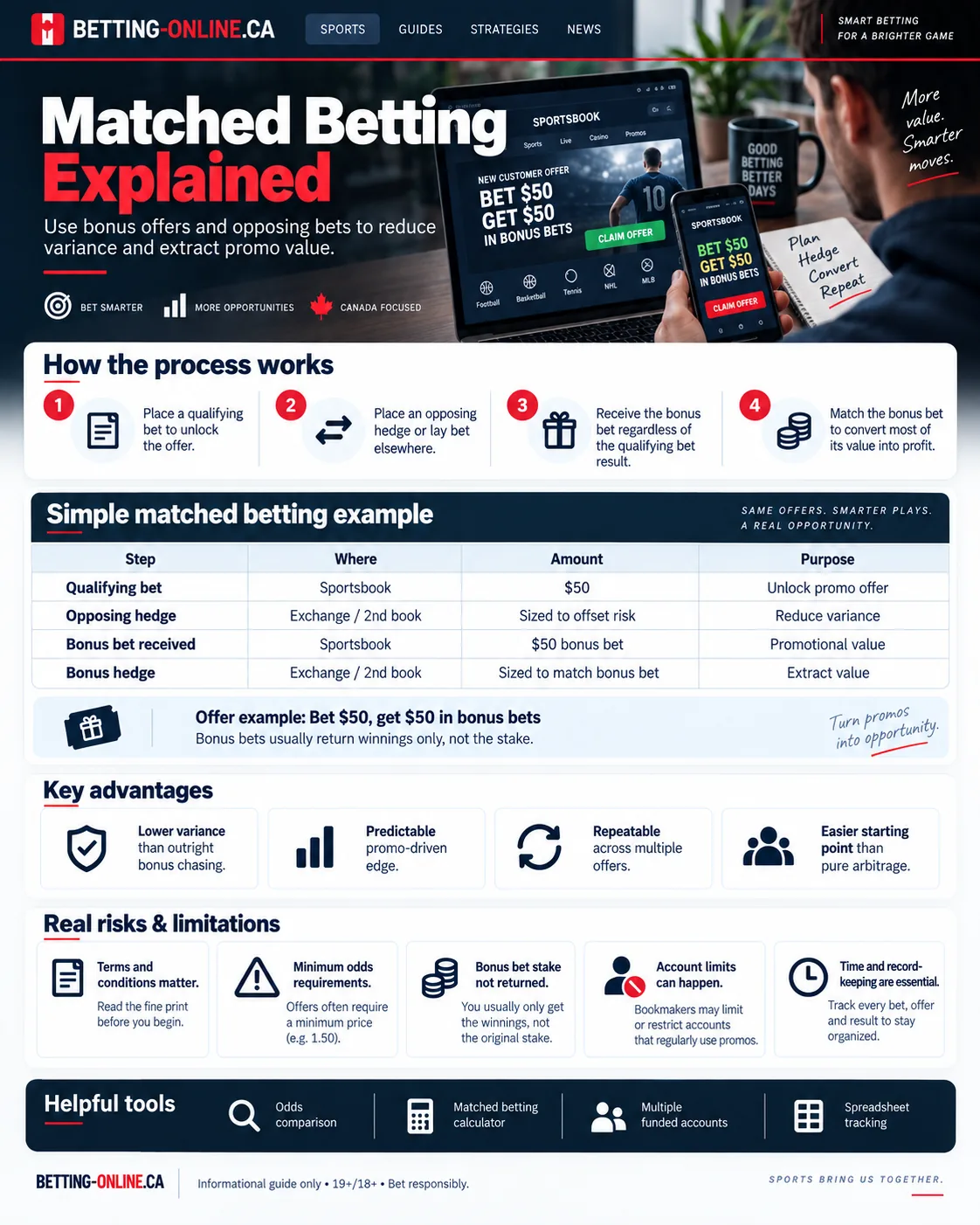
Example: “Bet $50, get $50 in bonus bets”
| Step | Where | Amount | Purpose |
|---|---|---|---|
| Qualifying bet | Sportsbook | $50 | Unlock the promotional offer |
| Opposing hedge | Exchange or second book | Sized to offset risk | Reduce variance on the qualifying bet |
| Bonus credited | Sportsbook | $50 bonus bet | Create promotional value |
| Bonus hedge | Exchange or second book | Sized to match bonus bet | Convert much of the bonus's value |
Bonus bet winnings commonly exclude the bonus stake itself. Minimum odds, expiry rules, eligible markets, and wagering conditions also matter. Review the exact terms before placing the qualifying bet.
Why exchanges can be useful
An exchange can let you “lay” an outcome directly, effectively betting against it. That can make offsetting a sportsbook position more precise than using a second traditional sportsbook. Availability varies by province and operator licensing, so a second sportsbook may be the practical alternative.
Recurring promotions need tracking
Reload bonuses, price boosts, refund offers, and other recurring promotions can sometimes be approached with similar matching logic, but the exact calculations depend on each offer's structure and terms.
Side-by-side
Arbitrage vs. matched betting
| Factor | Arbitrage betting | Matched betting |
|---|---|---|
| Value source | Pricing differences between books | Promotional offers and bonus value |
| Primary calculation | Combined implied probability + stake split | Qualifying/hedge stake + bonus conversion |
| Timing pressure | High; odds can disappear in seconds | Usually lower, but odds still move |
| Typical constraint | Rare opportunities and thin margins | Terms, bonus eligibility, and account restrictions |
| Main operational need | Fast odds comparison across books | Accurate promotion tracking and record keeping |
Reality check
Real risks and limitations
Time investment
Comparing prices, checking terms, sizing stakes, and recording outcomes can make the effective hourly return modest.
Account restrictions
Sportsbooks may limit stakes, restrict promotional eligibility, or otherwise reduce access for accounts that consistently show arbitrage or bonus-extraction patterns.
Execution risk
The first leg can be placed successfully while the second moves to a worse price, leaving an unintended exposure.
Terms & conditions
Minimum odds, expiry windows, stake-return rules, eligible markets, and settlement terms can materially change the result.
Stay organized
Record keeping, tax, and responsible use
Keep a record for every position
- Date and event
- Book or exchange used
- Market and exact settlement rules
- Odds and stake for every leg
- Bonus value, fees, and net result
Don't treat “lower variance” as “no risk”
- Prices can move before all legs are placed
- Offers can have restrictive or misunderstood terms
- Accounts can be limited or promotions removed
- Systematic activity may have tax or legal implications
Systematic matched betting or arbitrage carried out regularly and at meaningful volume can be different in character from occasional recreational betting. Clear records help you measure the strategy accurately and can be useful if tax or legal questions arise. This guide is general information, not professional tax or legal advice.
Important perspective
Is this “free money”?
No. The mathematics can reduce outcome risk substantially when every leg is priced, sized, and settled exactly as expected, but real-world execution risk, time cost, bookmaker restrictions, fees, and promotion terms remain. The techniques are mathematically grounded; the phrase “risk-free” is not a good description of the complete practical experience.
Next steps
Getting started cautiously
- Learn implied probability first. Both methods depend on understanding how prices translate into probability and how bookmaker margin works.
- Choose one simple example. A clearly understood welcome offer is usually easier to plan than scanning continuously for short-lived arbitrage opportunities.
- Use a calculator and written checklist. Confirm every leg before placing the first wager.
- Review the relevant terms. Read our Wagering Requirements Explained, Free Bets Explained, and Welcome Bonus Guide before using a promotion.
Our Sports Betting Strategy guide covers implied probability, value, line comparison, and bankroll discipline—the foundations both matched betting and arbitrage depend on.