
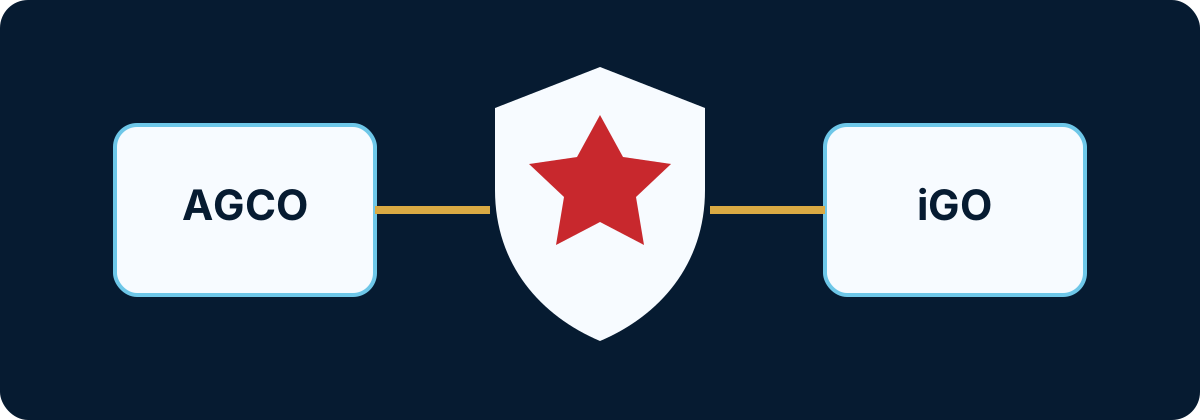
Ontario pioneered Canada's competitive private-operator iGaming model in 2022. Alberta launched a separate regulated competitive market in July 2026, so Ontario is no longer the only province offering multiple regulated private operators. This guide explains exactly how that system is structured: who regulates it, how operators are registered and authorized, and what that structure actually means for an Ontario bettor choosing where to play.
Two organizations, two different jobs
It's easy to conflate the AGCO and iGaming Ontario, since they're closely connected and often mentioned together, but they perform genuinely distinct functions within Ontario's regulatory structure.
The Alcohol and Gaming Commission of Ontario (AGCO) is Ontario's broader gaming and liquor regulator, with authority extending well beyond online betting - it also regulates physical casinos, horse racing, and liquor licensing across the province. The AGCO sets the overall regulatory standards and rules that any gambling operator in Ontario, online or physical, must meet.
iGaming Ontario (iGO) is a standalone provincial agency responsible for conducting and managing private-operator iGaming in Ontario. Private operators register with the AGCO and must also execute an operating agreement with iGO before going live. In practical terms: the AGCO is the regulator, while iGO is the commercial conduct-and-manage entity for the private iGaming market.
How the open market actually came to exist
Before April 2022, Ontario residents accessing online gambling generally used either the province's own government-operated lottery platform (similar to the provincial-platform model that still exists across much of Canada) or offshore-licensed operators outside any Canadian regulatory framework - see Is Online Betting Legal in Canada? for how that grey-market category works. Ontario's decision to open a regulated, competitive private market was, at the time, a genuinely significant departure from how every other Canadian province had approached online gambling, driven partly by the recognition that a large volume of Ontario betting activity was already flowing to unregulated offshore operators, with none of the consumer protection or tax revenue that a domestically regulated market could capture.
Since launch, dozens of operators - a mix of established international sportsbook and casino brands along with some Canadian-specific platforms - have completed Ontario registration and authorization, giving the province genuinely competitive dynamics around odds, game selection, and bonus offers that are less available in single-platform provincial models.
What it takes for an operator to get licensed
An operator seeking to enter Ontario's regulated market must complete registration with the AGCO and execute an operating agreement with iGaming Ontario. The process includes eligibility and integrity review, technical compliance for the platform and games (including the RNG certification discussed in our game review methodology), and demonstrated compliance with Ontario's responsible gambling standards, including the specific player-protection tools required of every licensed operator. This isn't a one-time check - registered operators are subject to ongoing compliance monitoring, and the AGCO retains authority to investigate, sanction, suspend or revoke a registration from an operator found to be out of compliance with Ontario's standards after launch.
What this means for a player choosing an operator
Because Ontario has genuine competition among licensed operators, the practical advice for an Ontario bettor differs somewhat from a bettor in a province with only one primary regulated online platform: it's worth actively comparing multiple licensed operators rather than defaulting to whichever one you happen to encounter first, since real differences in odds, game selection, platform quality, and bonus terms exist between Ontario-licensed operators in a way that simply doesn't apply where only one legal platform exists. Our Sports Betting Strategy guide covers line shopping across multiple operators as a genuinely valuable habit specifically because Ontario's market structure makes it possible in the first place.
Confirming an operator's Ontario license
Before creating an account with any operator claiming to serve Ontario, confirm their license status directly - legitimate Ontario-regulated operators should be verifiable against the province's current regulated-operator information. A private operator must be registered by the AGCO and have an operating agreement with iGaming Ontario before offering games in the regulated market. This confirmation step is worth doing even for well-known, recognizable brand names, since a global operator's presence in other markets doesn't automatically confirm current, valid Ontario licensing - see our sportsbook review methodology for how licensing verification is the first, non-negotiable check we apply before reviewing any operator.
Responsible gambling requirements specific to Ontario
Ontario's licensing framework requires operators to build in specific player-protection tools as a condition of maintaining their license - deposit limits, self-exclusion options, and mandatory advertising standards that, among other things, restrict certain marketing practices (like the use of celebrity endorsements in a way that might appeal disproportionately to younger audiences) that regulators in other jurisdictions have historically allowed with fewer restrictions. Ontario also participates in a broader self-exclusion framework that can, depending on how a player enrolls, extend across multiple licensed operators simultaneously rather than requiring a separate exclusion request at each platform individually - full detail on this is covered in Self-Exclusion & Player Protection Programs.
How Ontario's tax and revenue model works
Licensed Ontario operators pay a share of their gaming revenue to the province as part of their agreement with iGaming Ontario, a structure that was a core part of the original rationale for opening a regulated market in the first place - capturing tax revenue from betting activity that regulators recognized was already happening through offshore, unregulated platforms, without any of that revenue flowing back to the province. This revenue-sharing structure is separate from any tax obligations an individual player might have - gambling winnings for recreational Canadian bettors are generally not considered taxable income under current federal tax treatment, a distinction worth understanding as a general principle, though anyone with questions about their own specific tax situation, particularly around more frequent or higher-volume betting activity, should consult a qualified tax professional rather than relying on general information here.
How Ontario's model has influenced discussion in other provinces
Ontario's open-market experiment hasn't gone unnoticed elsewhere in Canada - the results, both in terms of tax revenue capture and the practical experience of managing a competitive licensing regime, have become a reference point in ongoing policy discussions in other provinces considering whether to move away from the single-operator model. Alberta, discussed in our Province-by-Province Guide, launched its own regulated competitive iGaming market on July 13, 2026. Ontario remains distinct in its institutional structure, but it is no longer Canada's only province with multiple regulated private operators. Whether other provinces follow is a live question worth watching if you're interested in how Canadian gambling regulation continues to evolve - our News section is where developments like this get covered as they happen.
The transition period and legacy platforms
When Ontario's regulated market launched in April 2022, operators that had previously served Ontario customers without a Canadian license (the offshore category discussed in Is Online Betting Legal in Canada?) were given a defined transition window either to obtain an Ontario license and continue serving Ontario residents legally, or to exit the Ontario market entirely. This transition was a significant, one-time event in Ontario's regulatory history - it meant that a number of platforms Ontario bettors may have used previously, without any Canadian-specific license, either became properly licensed Ontario operators or stopped serving Ontario residents altogether. This history is part of why checking an operator's current Ontario license status directly remains worthwhile even for platforms with a long track record - that track record may predate the operator's actual Ontario licensing, if it holds one now at all.
What happens when an operator loses its Ontario license
Ontario's framework includes real enforcement mechanisms - the AGCO retains authority to suspend or revoke a license from an operator found to be materially out of compliance with its regulatory standards, whether around game fairness, financial practices, responsible gambling requirements, or advertising standards. When this happens, an operator is required to wind down Ontario operations, which typically includes a defined process for returning player funds. This enforcement capability is part of what distinguishes licensed Ontario operators from the offshore category discussed in Is Online Betting Legal in Canada? - there's a real regulator with real authority to act if a licensed operator fails to meet its obligations, not merely a one-time approval with no ongoing oversight.
Advertising standards and the "single wallet" discussion
Ontario's regulatory approach has evolved since the market's 2022 launch, including periodic updates to advertising standards aimed at balancing legitimate marketing with responsible gambling concerns, particularly regarding sports broadcast advertising volume. Ontario has also periodically discussed moving toward a "single wallet" model - allowing a player's funds and account status to move more seamlessly between different licensed operators, or centralizing certain account functions - though as of this writing, each licensed operator maintains its own separate account system, and a player choosing to use multiple Ontario-licensed platforms manages separate accounts, balances, and verification with each individually.
How Ontario compares to the rest of Canada
| Ontario | Most other provinces | |
|---|---|---|
| Number of legal operators | Dozens, competing | One (the provincial lottery platform) |
| Oversight structure | AGCO regulator; iGaming Ontario conduct-and-manage agency | Varies by province |
| Price/bonus competition | Genuine, since multiple operators compete | None - no alternative domestic platform to compare against |
| Player choice | Significant | Limited to the single available platform |
This structural difference is the single biggest reason Ontario-specific content - including line shopping advice and multi-operator bonus comparison - appears throughout this site, since it is most directly applicable where multiple regulated operators compete. Alberta now also supports operator comparison under its own 2026 framework. See our full Province-by-Province Guide for the current provincial picture.
Player eligibility and the registration process itself
Registering as an iGaming Ontario-licensed operator isn't a simple form submission - it's a comprehensive process that typically takes many months, including detailed review of the applicant's corporate structure, financial standing, ownership, and existing regulatory history in other jurisdictions if the operator already holds licenses elsewhere. This lengthy process is part of why the Ontario market, despite launching with a genuinely large number of licensed operators, didn't include every internationally known betting brand from day one - some entered later as their own registration process completed, and a small number of applicants have not received Ontario licensing at all, whether by choice or as a result of the AGCO's review findings. This vetting process is precisely the mechanism that gives Ontario licensing its practical meaning for a player - it's not simply a formality, but a genuine filter applied before any operator is permitted to serve Ontario residents legally.
Accessibility and language availability
Accessibility obligations can apply to Ontario businesses under provincial law, while the gambling-specific rules are set through the AGCO's standards and related requirements. Language availability can still vary between individual operators, so players who specifically need French-language interfaces or support should verify those features before registering rather than assuming every regulated site offers the same level of bilingual service. Ontario's regulatory status is separate from Quebec's provincial and Kahnawake frameworks, discussed in our Province-by-Province Guide.
Where to go from here
For the full picture of how Ontario's system fits alongside the rest of Canada's regulatory landscape, see Province-by-Province Guide and the broader Is Online Betting Legal in Canada? guide. For how to actually choose among Ontario's many licensed operators, see How We Review Sportsbooks.