

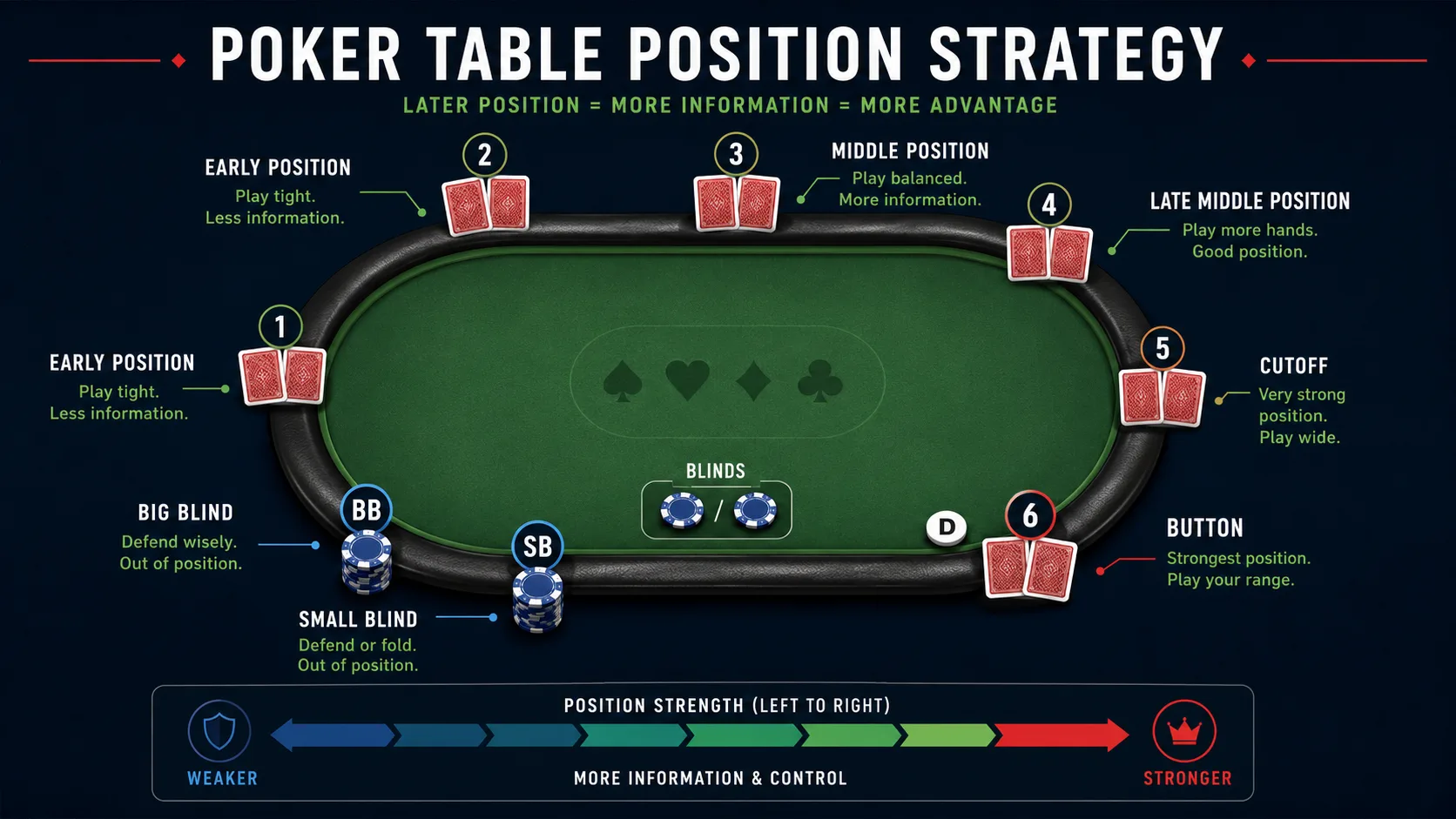
Acting later gives you more information and more control over pot size and pressure.
Most new players lose more from loose pre-flop play than from any later mistake.
One session means little. The quality of repeated decisions matters far more.
Good players still face variance. A proper bankroll keeps you in action long enough for skill to matter.
Tight is profitable
Strong starting hand discipline is the easiest way for newer players to improve quickly and cut unnecessary losses.
Position changes everything
The same hand can be strong on the button and weak in early position because the information flow is different.
Variance is real
Even correct poker decisions can lose in the short run. Your bankroll has to absorb that reality.
Poker strategy in one minute
If you want a short practical summary before the deeper detail, these are the most valuable first rules to keep in mind.
- Play fewer hands, especially from early position. Folding is not passive - it is how you protect your stack from weak spots.
- Respect table position. Late position lets you steal blinds, control pot size, and react to other players' actions.
- Value bet more than you bluff. Newer players usually gain more by betting strong hands well than by forcing fancy bluffs.
- Track pot odds and stack sizes. Good poker decisions are math plus context, not only feel.
- Keep a dedicated bankroll. Cash games and tournaments need different bankroll depth because their variance profiles differ.
The five poker pillars that matter most
There are countless tactics in poker, but nearly all of them sit on top of a few foundational concepts. Get these right first.
1. Starting hands
Premium hands like big pairs and strong big-card combinations are profitable from almost anywhere. Marginal hands need stronger table conditions and usually later position.
2. Position
The later you act, the more information you own. That lets you bluff more effectively, value bet more clearly, and avoid expensive guessing games.
3. Aggression
Good poker usually rewards controlled aggression. Betting and raising with a plan is stronger than calling passively and hoping the hand improves.
4. Pot odds
Before calling, compare the price you are getting with the chance that your draw or hand is actually good enough to continue profitably.
5. Emotional control
Tilt destroys solid technical play. The stronger your emotional discipline, the easier it becomes to keep making repeatable decisions.
Bonus edge: table selection
Picking softer games can matter as much as improving your own mechanics. If a table is full of sharp regulars, moving can be the best strategy.
Why position matters more than most beginners expect
A decent hand played in late position can outperform a stronger-looking hand played from a bad seat. Position is not a small detail - it is one of poker's main structural edges.
| Seat group | General idea | How to adjust |
|---|---|---|
| Early position | You act first and face the most uncertainty. | Open tighter ranges, avoid weak offsuit hands, and be cautious with speculative holdings. |
| Middle position | You have a little more information and room to widen. | Add more suited broadway hands and medium pairs when table conditions are calm. |
| Cutoff / Button | You act late and pressure blinds more effectively. | Open wider, steal blinds selectively, and use position to control pot size. |
| Small blind / Big blind | You are forced into awkward spots more often. | Defend with discipline, not ego. Avoid over-calling with dominated hands. |
Cash games vs tournaments
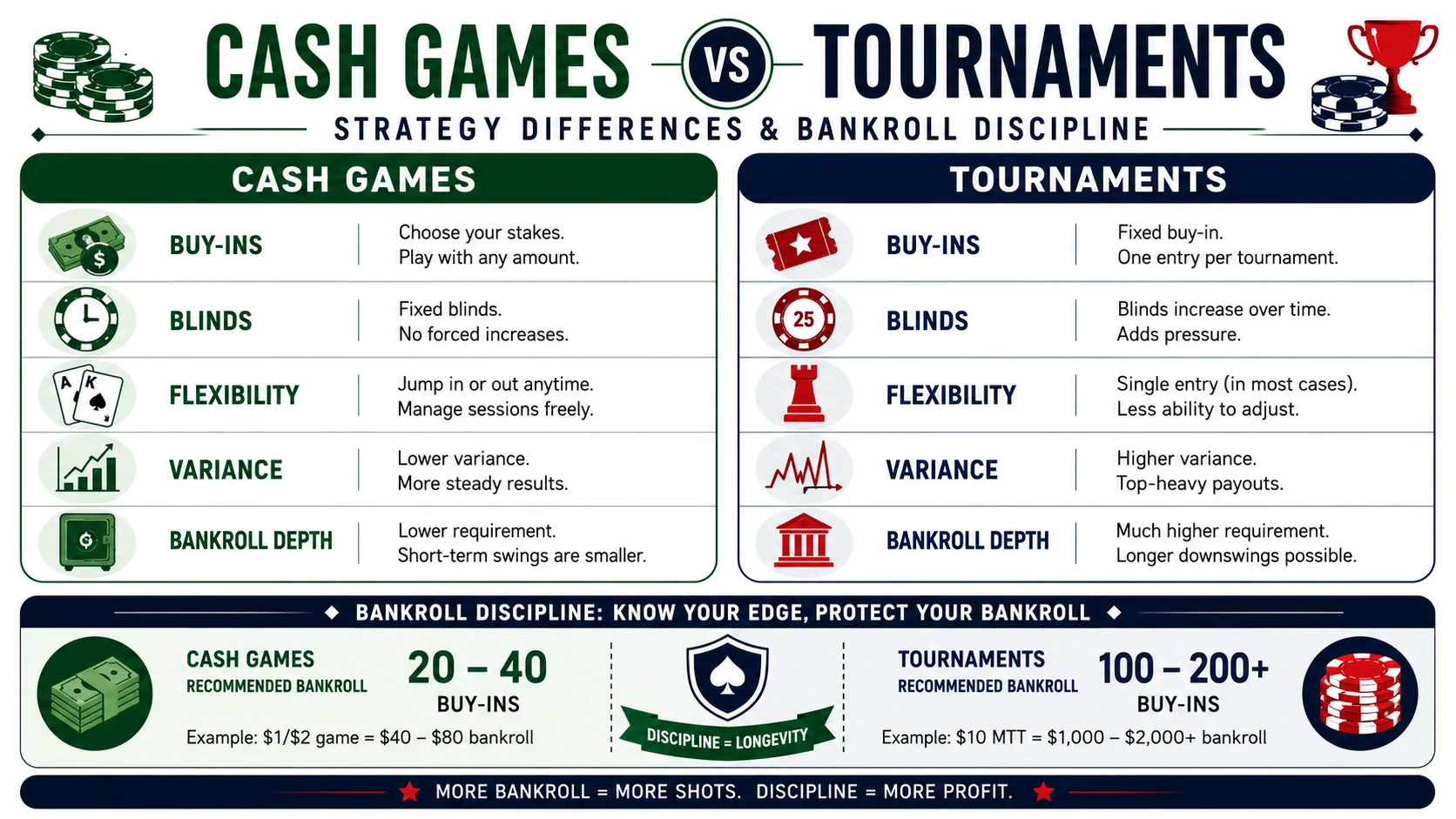
The right poker strategy depends heavily on the format you are playing. Cash games and tournaments may use the same hand rankings, but they reward different types of discipline.
Cash game mindset
Think in terms of stable fundamentals. You can reload, leave anytime, and grind edges through solid pre-flop ranges, value betting, and smart table selection.
- Focus on decision quality over session drama.
- Play comfortable stakes with enough buy-ins behind you.
- Avoid defending blinds too loosely just because the money feels immediate.
Tournament mindset
Think in terms of survival plus pressure. Blinds rise, stack depth changes, and payout jumps create spots where aggression and stack management matter more than raw chip accumulation alone.
- Adjust ranges as effective stacks get shorter.
- Respect bubble pressure and ICM effects late.
- Expect longer downswings due to top-heavy payouts.
Cash bankroll
A common practical target is about 20 to 40 buy-ins for your stake level, depending on game softness and your own edge.
Tournament bankroll
Many players keep 100 to 200+ buy-ins because busting before cashing is normal in top-heavy fields.
Cash variance
Usually lower than tournaments because stack depth stays more stable and you can leave whenever you want.
Tournament variance
Usually higher because field size, blind escalation, and payout concentration create bigger bankroll swings.
Pot odds, bankroll, and practical discipline
Poker is not solved by raw instinct alone. The most durable players combine observation with simple, repeatable math and conservative bankroll habits.
| Concept | What it means | Why it matters |
|---|---|---|
| Pot odds | The price you are getting to continue compared with the size of the pot. | Helps decide whether a call is profitable or simply emotional. |
| Implied odds | Potential future chips you can win if your hand improves. | Makes some drawing hands worth continuing when stacks are deep enough. |
| Fold equity | The chance your bet or raise makes opponents fold. | Turns aggression into a real weapon even without the best current hand. |
| Bankroll buffer | The number of buy-ins or entries you keep separate from everyday money. | Protects you from variance so skill has time to show up in results. |
Pre-session rule
Choose your stake before you sit down. If the game is bigger than your bankroll plan allows, skip it. Discipline starts before the first hand.
During-session rule
Record hands that felt confusing or emotionally charged. Review them later with a clear head rather than trying to solve everything mid-session.
Post-session rule
Judge yourself by the quality of decisions, not whether one river card helped or hurt. Good process is the real long-term metric.
Common beginner mistakes
Many poker leaks are predictable. Spotting them early can save a lot of bankroll and frustration.
Playing too many hands
Loose curiosity often looks harmless, but it forces you into too many dominated or unclear post-flop spots.
Ignoring position
Using the same pre-flop ranges from every seat removes one of the clearest strategic edges available.
Calling too much
Passive calling weakens your range and surrenders initiative. Betting or folding is often cleaner than drifting.
Bluffing the wrong players
Some opponents simply hate folding. Fancy lines against obvious calling stations usually burn money.
Chasing losses
Moving up in stakes after a bad beat or bad session is a bankroll trap, not a recovery plan.
Letting tilt lead
The emotional cost of one bad river can ruin an hour of otherwise decent decisions. Stepping away is often correct strategy.
- Do not confuse winning a hand with playing it well. Short-term outcomes are noisy.
- Do not confuse a stylish bluff with a profitable one. Most of the money in low and mid stakes comes from value and discipline.
- Do not confuse action with skill. Good poker often looks patient from the outside.