
European Roulette Guide
Learn the rules, compare the bets and understand the odds.
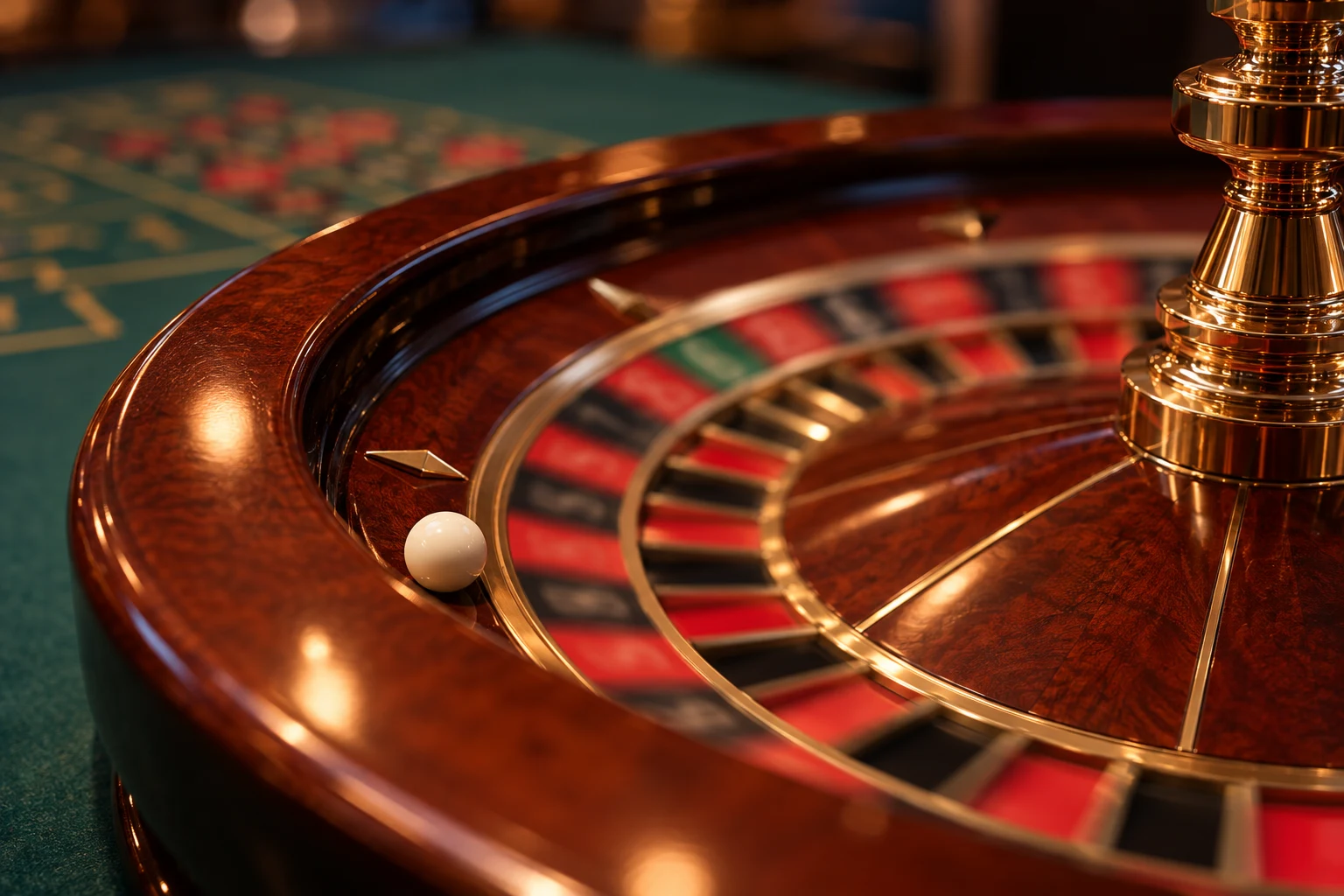
European roulette is the most widely played version of roulette in the world and the default choice at most online casinos serving Canada. It uses a single-zero wheel, which gives it a house edge of just 2.70%, roughly half that of American roulette. It is easy to learn, flexible enough for low-stakes players and high rollers alike, and available in more formats than any other version, from classic digital tables to live dealer games with multipliers.
This complete guide to European roulette for Canadian players covers everything you need to know: the wheel and table layout, every bet and its payout, the real odds, the most popular game variations, betting strategies, practical tips and where to play European roulette online in Canada.
What this guide covers
- What European roulette is
- Where European roulette came from
- The European roulette wheel
- The table layout
- How to play, step by step
- Inside bets and payouts
- Outside bets and payouts
- Racetrack and call bets
- Odds, probability and house edge
- European vs French vs American roulette
- European roulette variations
- Strategies and betting systems
- Bankroll management
- Tips and common mistakes
- Playing European roulette online in Canada
- Frequently asked questions
What Is European Roulette?
European roulette is a casino table game in which a ball is spun around a wheel with 37 numbered pockets: the numbers 1 to 36, coloured red and black, plus a single green zero. Players place bets on where the ball will land. If the ball settles in a pocket covered by your bet, you win according to that bet's payout.
The game's popularity comes down to three things. It is simple, because the rules can be learned in minutes. It offers a huge range of bets, from long-shot single numbers paying 35 to 1 to near-coin-flip bets on red or black. And it is fairer than American roulette, thanks to having only one zero.
Where European Roulette Came From
Roulette developed in 18th-century France, but early wheels had both a single and a double zero. In 1843, François and Louis Blanc opened a casino in Bad Homburg, Germany, and introduced a wheel with a single zero to give players better odds than their competitors offered. The idea was a success.
When François Blanc later took over the casino at Monte Carlo, the single-zero wheel became the standard across Europe. When the game travelled to North America, casinos there kept the double zero, which is why today we have both European and American roulette. European roulette is essentially the same game as French roulette, but usually played on a standard English-language layout and without the La Partage rule.
The European Roulette Wheel
The wheel has 37 pockets. The 36 numbered pockets alternate red and black, and the zero is green. The numbers are placed in a fixed sequence that spreads high and low, odd and even, and red and black around the wheel as evenly as possible. Going clockwise from zero, the order is:
0, 32, 15, 19, 4, 21, 2, 25, 17, 34, 6, 27, 13, 36, 11, 30, 8, 23, 10, 5, 24, 16, 33, 1, 20, 14, 31, 9, 22, 18, 29, 7, 28, 12, 35, 3, 26
You do not need to memorize this order to play, but it becomes useful if you want to try racetrack bets that cover sections of the wheel. A modern wheel is precision-engineered and balanced so that every pocket has an equal chance of catching the ball, and online RNG versions are independently tested to the same standard.
The European Roulette Table Layout
The betting table is divided into two main areas.
- The inside section is a grid of the numbers 1 to 36 arranged in three columns and 12 rows, with the zero at the top. Bets placed on individual numbers or small groups of adjacent numbers are called inside bets.
- The outside section runs along the edges of the grid and includes boxes for red, black, odd, even, 1 to 18, 19 to 36, the three dozens and the three columns. These are outside bets.
Most online versions also show a racetrack, an oval diagram of the wheel, where you can place bets on neighbouring numbers and classic call bets.
How to Play European Roulette, Step by Step
- Choose your chip size. Select a chip value from the chip tray. Check the table minimum and maximum before you start.
- Place your bets. Click on the layout to place chips. You can place as many bets as you like within the table limits.
- Spin. In digital roulette, press the spin button. In live roulette, the dealer spins the wheel when the betting time runs out.
- See the result. The ball lands in a pocket, and the winning number is shown on screen.
- Get paid. Winning bets are paid automatically, and losing bets are cleared from the table.
- Repeat or rebet. Most games offer a "rebet" button to place the same bets again, and a "double" button to double them.
Beginner tip: Start with outside bets like red or black. They win almost half the time, so your bankroll lasts longer while you get used to the pace of the game.
Inside Bets and Payouts
| Bet | How to Place It | Payout | Win Chance |
|---|---|---|---|
| Straight up | On a single number | 35 to 1 | 2.70% |
| Split | On the line between two numbers | 17 to 1 | 5.41% |
| Street | At the end of a row of three | 11 to 1 | 8.11% |
| Trio or basket | 0-1-2 or 0-2-3 | 11 to 1 | 8.11% |
| Corner | Where four numbers meet | 8 to 1 | 10.81% |
| First four | Covering 0, 1, 2 and 3 | 8 to 1 | 10.81% |
| Six line | At the end, between two rows | 5 to 1 | 16.22% |
Inside bets are popular with players who enjoy bigger potential wins. Covering a few favourite numbers with straight-up and split bets is one of the most common ways to play.
Outside Bets and Payouts
| Bet | Numbers Covered | Payout | Win Chance |
|---|---|---|---|
| Red or Black | 18 | 1 to 1 | 48.65% |
| Odd or Even | 18 | 1 to 1 | 48.65% |
| Low (1 to 18) | 18 | 1 to 1 | 48.65% |
| High (19 to 36) | 18 | 1 to 1 | 48.65% |
| Dozen | 12 | 2 to 1 | 32.43% |
| Column | 12 | 2 to 1 | 32.43% |
Notice that the chance of winning an even-money bet is slightly under 50%. That small gap is caused by the zero, which is neither red nor black, odd nor even, high nor low. When zero comes up, all outside bets lose.
Racetrack and Call Bets
Many European roulette games include a racetrack, letting you bet on sections of the wheel rather than the table. The classic options, borrowed from French roulette, are:
- Voisins du Zéro: 17 numbers around zero, from 22 to 25, using 9 chips.
- Tiers du Cylindre: 12 numbers on the side of the wheel opposite zero, from 27 to 33, using 6 chips.
- Orphelins: the 8 remaining numbers, using 5 chips.
- Jeu Zéro: the 7 numbers closest to zero, using 4 chips.
- Neighbour bets: a chosen number plus its neighbours on each side, usually two on each side for 5 chips.
These bets are made up of standard straight-up, split, trio and corner bets, so they carry the same 2.70% house edge as everything else. They are popular because they let you play the wheel visually, and they are quick to place.
Odds, Probability and House Edge
Every bet in roulette pays slightly less than its true odds would justify. On a European wheel, the true odds of hitting a single number are 36 to 1 (one winning pocket against 36 losing ones), but the payout is 35 to 1. That difference is the house edge.
The house edge on every standard bet in European roulette is 2.70%, which equals a return to player of 97.30%. It does not matter whether you bet on a single number or on red: the expected loss over time is the same.
What the house edge means in practice
The house edge describes what happens over a very large number of spins. If you wager a total of $1,000 over a session, the average expected loss is about $27. In the short term, anything can happen, and that is exactly what makes roulette exciting. But over thousands of spins, results move toward the expected value.
How often each bet wins
Volatility is just as important as house edge when choosing your bets. A red or black bet wins nearly half the time, giving you a smooth ride with small, frequent wins. A straight-up bet wins on average once every 37 spins, so you may go a long time without a win, but each win pays 35 times your stake.
| Bet | Average Wins per 37 Spins | Volatility |
|---|---|---|
| Even-money | 18 | Low |
| Dozen or column | 12 | Low to medium |
| Six line | 6 | Medium |
| Corner | 4 | Medium to high |
| Split | 2 | High |
| Straight up | 1 | Very high |
European vs French vs American Roulette
| Feature | European | French | American |
|---|---|---|---|
| Pockets | 37 | 37 | 38 |
| Zeros | 0 | 0 | 0 and 00 |
| House edge | 2.70% | 1.35% to 2.70% | 5.26% |
| La Partage | Usually no | Yes | No |
| Layout language | English | French | English |
| Availability online | Very wide | Wide | Wide |
European roulette is the best all-round choice for most players. French roulette is slightly better for even-money bets if La Partage is offered, while American roulette has nearly double the house edge and is best avoided if a single-zero table is available.
European Roulette Variations
Online casinos offer dozens of variations built on the European wheel. Here are the most popular ones you will find at Canadian-friendly casinos.
Classic digital European roulette
The standard RNG version from software providers. Spins are instant, minimum bets can be very low, and many casinos offer free demo play.
Live dealer European roulette
A real croupier spins a real wheel in a studio or casino, streamed to your screen in high definition. You place bets on a digital layout during a timed betting window. Live roulette is slower and more social, with chat features and multiple camera angles.
Lightning Roulette and multiplier games
These live games add random multipliers to one or more straight-up numbers on each spin, boosting their payouts dramatically. To fund the multipliers, straight-up wins on non-multiplied numbers pay less than the usual 35 to 1. They are exciting but more volatile, so always read the payout table.
Immersive Roulette
A live game filmed with multiple high-speed cameras, including slow-motion replays of the ball as it lands. It plays like standard European roulette but with a more cinematic presentation.
Speed and Auto Roulette
Speed roulette shortens the betting window and spin time, delivering many more rounds per hour. Auto roulette uses an automated wheel with no dealer. Both are fast, so they can increase how much you wager in a session.
Double Ball Roulette
Two balls are launched at once, and you can bet on either or both balls landing on certain outcomes. Payouts and house edge differ from standard roulette, so check the rules.
Multi-Wheel Roulette
Your bets are applied to several wheels spinning at the same time, usually up to eight. It multiplies both your potential wins and your total stake per round.
Mini Roulette
A smaller wheel with only 13 pockets, numbers 1 to 12 plus a zero. It is simple and fun, but the house edge is much higher, around 7.69% on standard bets.
Low-stakes and high-roller tables
Casinos offer European tables to suit every budget, from minimum bets of a few cents to VIP tables accepting thousands of dollars per spin.
Strategies and Betting Systems
No strategy can change the 2.70% house edge, because every spin is independent. However, betting systems can shape how your session plays out, and choosing your bets carefully lets you control risk.
Martingale
After every loss on an even-money bet, double your stake. After a win, return to your starting bet. In theory, one win recovers all losses plus a one-unit profit. In practice, losing streaks can push your bets to the table maximum or beyond your bankroll very quickly.
Reverse Martingale
Double your bet after each win and return to your base stake after a loss. Set a target, such as three wins in a row, then reset. Your losses stay small, and you capitalise on hot streaks.
D'Alembert
Increase your bet by one unit after a loss and decrease it by one unit after a win. Changes are gradual, making it one of the safest progressive systems.
Fibonacci
Follow the sequence 1, 1, 2, 3, 5, 8, 13, 21, moving one step up after a loss and two steps back after a win. Bets rise more slowly than Martingale, but long losing runs can still be costly.
James Bond strategy
A flat betting pattern that covers most of the wheel with a $200 total stake: $140 on high (19 to 36), $50 on the six line 13 to 18, and $10 on zero. You win on 25 of the 37 numbers. Results depend on where the ball lands: high numbers return a small profit, 13 to 18 returns a larger profit, zero returns a big profit, and 1 to 12 loses the full stake.
Dozen and column coverage
Betting on two dozens or two columns at once covers 24 numbers, winning about 65% of the time. Each win returns a small profit, but a loss costs both bets.
Reality check: Every system above has the same long-term expected loss as flat betting. Use systems for structure and fun, never as a way to guarantee profits.
Bankroll Management
- Set a session budget and treat it as the cost of entertainment.
- Size your bets so your budget covers at least 50 base bets.
- Set a loss limit and a win goal. Stop when you reach either one.
- Use the casino's tools. Deposit limits, loss limits and session reminders help you stay in control.
- Keep winnings separate. Consider withdrawing part of any big win rather than playing it all back.
- Watch the clock. Fast digital games can deliver hundreds of spins an hour.
European Roulette Terms to Know
| Term | Meaning |
|---|---|
| Single zero | The one green pocket that defines European roulette |
| Racetrack | Oval betting area showing the wheel order |
| Neighbours | Numbers sitting next to each other on the wheel |
| Croupier | The dealer who spins the wheel and pays bets |
| Dolly | Marker placed on the winning number |
| Rebet | Button that repeats your previous bets |
| Table limits | Minimum and maximum bets allowed |
| RTP | Return to player, the long-term percentage paid back |
Choosing Between Digital and Live European Roulette
Both formats use the same rules and the same 2.70% house edge, but they suit different players. Digital roulette is ideal if you want low stakes, quick sessions or free demo play. Live roulette is better if you enjoy watching a real wheel, chatting with the dealer and playing at a relaxed pace. Because live games deliver fewer spins per hour, your total expected loss per hour is usually lower, even at the same bet size. Many players practise on digital tables first, then move to live tables once they are comfortable with the layout.
Tips and Common Mistakes
Tips
- Always choose European over American roulette when both are available.
- Look for French roulette with La Partage if you mainly bet on even-money outcomes.
- Practise in demo mode to learn the layout and test systems without risk.
- Mix low- and high-volatility bets to balance steady wins with bigger payouts.
- Check multiplier game payouts, since some bets pay less than standard roulette.
- Read bonus terms, because roulette often contributes little to wagering requirements.
Mistakes to avoid
- Believing in the gambler's fallacy. Ten reds in a row does not make black more likely next.
- Chasing losses with bigger and bigger bets.
- Covering too many numbers. Betting on nearly every number guarantees small losses on most spins.
- Ignoring table limits when using progressive systems.
- Playing on unlicensed sites with no regulatory protection.
Playing European Roulette Online in Canada
The legal picture
Gambling in Canada is regulated provincially. Ontario has a regulated private online casino market overseen by iGaming Ontario and the AGCO. Alberta became the second province to open a regulated private market in July 2026. Other provinces offer official online casinos through their lottery corporations, including PlayNow, Loto-Québec and Atlantic Lottery. The legal age is 19 in most provinces and 18 in Alberta, Manitoba and Quebec.
What to look for
- A valid provincial licence or a reputable international licence
- A strong selection of European roulette tables, both digital and live
- Low minimum bets and higher-limit tables to suit your budget
- Canadian dollar accounts and Interac deposits and withdrawals
- Fast, fee-free withdrawals
- Mobile-friendly games for play on phones and tablets
- Responsible gambling tools that are easy to find
Mobile European roulette
European roulette works perfectly on mobile. Most games adapt to portrait mode, with a compact betting grid and easy access to the racetrack. Live dealer games stream smoothly on modern phones, especially over Wi-Fi.
Taxes
For recreational players, gambling winnings are generally not taxable in Canada.
Responsible Gambling
Roulette should always be entertainment. Set limits, take breaks and never gamble with money you need for essentials. If gambling stops being fun, help is available:
- ConnexOntario for players in Ontario, available 24/7.
- GameSense, a responsible gambling program used by several provinces.
- Responsible Gambling Council, a national independent organization.
Frequently Asked Questions About European Roulette
What is the house edge in European roulette?
The house edge is 2.70% on every standard bet, giving an RTP of 97.30%.
How many numbers are on a European roulette wheel?
There are 37 pockets: the numbers 1 to 36 and a single green zero.
Is European roulette better than American roulette?
Yes. European roulette has one zero instead of two, which reduces the house edge from 5.26% to 2.70%.
What is the safest bet in European roulette?
Even-money bets such as red or black win most often, at 48.65% of spins. They do not have a lower house edge, but they have the lowest volatility.
What happens if the ball lands on zero?
All outside bets lose, as do inside bets that do not include zero. Only bets covering zero win. In French roulette with La Partage, even-money bets lose only half their stake.
Can I play European roulette for free?
Yes. Many online casinos and game providers offer demo versions of digital European roulette.
Is online European roulette fair?
At licensed casinos, digital roulette uses certified random number generators, and live games use real wheels inspected regularly. Both are independently tested.
What is the best strategy for European roulette?
No strategy beats the house edge. The best approach is to choose single-zero tables, manage your bankroll, pick bets that match your risk tolerance and play for enjoyment.
Final Thoughts
European roulette is popular for good reason: it is easy to learn, offers a huge variety of bets and comes with a fair 2.70% house edge. Start with simple outside bets, explore inside and racetrack bets as you grow more confident, and try the live and multiplier variations when you want something new. Above all, set a budget, play at licensed casinos and enjoy every spin.