
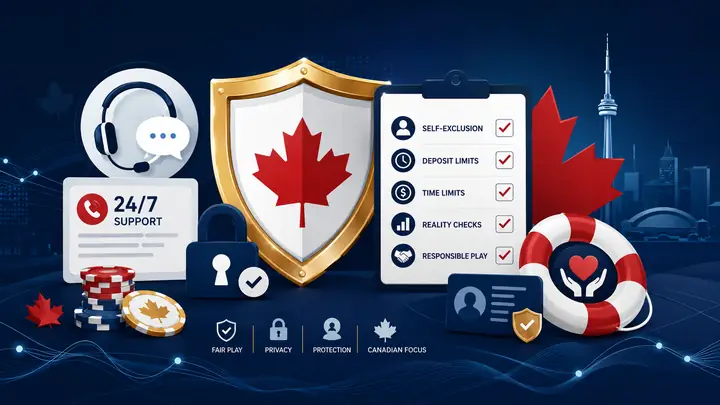
iGaming Ontario launched BetGuard on May 14, 2026, creating a single self-exclusion route across Ontario's regulated private iGaming market.
Before a centralized system, a player who wanted to stop gambling across many licensed sites could face a fragmented process. BetGuard is designed to create one market-wide barrier instead.
What BetGuard does
- Prevents access to existing accounts at regulated Ontario iGaming sites.
- Prevents creation of new accounts while the exclusion is active.
- Stops regulated operators from sending marketing communications to the excluded person.
- Uses identity verification so the exclusion can be matched across participating regulated sites.
How long can someone self-exclude?
BetGuard offers standard choices including six months, one year and five years, along with a custom-term option. The term cannot simply be shortened after enrolment, although it can be extended.
Why centralized exclusion matters
Ontario has dozens of operators and many more individual gaming sites. A system that requires a person in difficulty to contact each brand separately creates friction at exactly the moment when the process should be simple. Centralization turns a long list of separate actions into one decision.
What information is required
BetGuard's public guidance says users need identity information, a valid government photo ID, a cellphone, an email address and access to a device with a camera for identity verification.
How this changes our player-protection guide
Our Self-Exclusion & Player Protection page now treats BetGuard as a central part of Ontario's responsible-gambling framework rather than describing self-exclusion only at the individual-operator level.
Sources and verification
Figures and regulatory details were checked against the following official or industry sources. Market figures can be revised after publication.